
Komposition (2008)
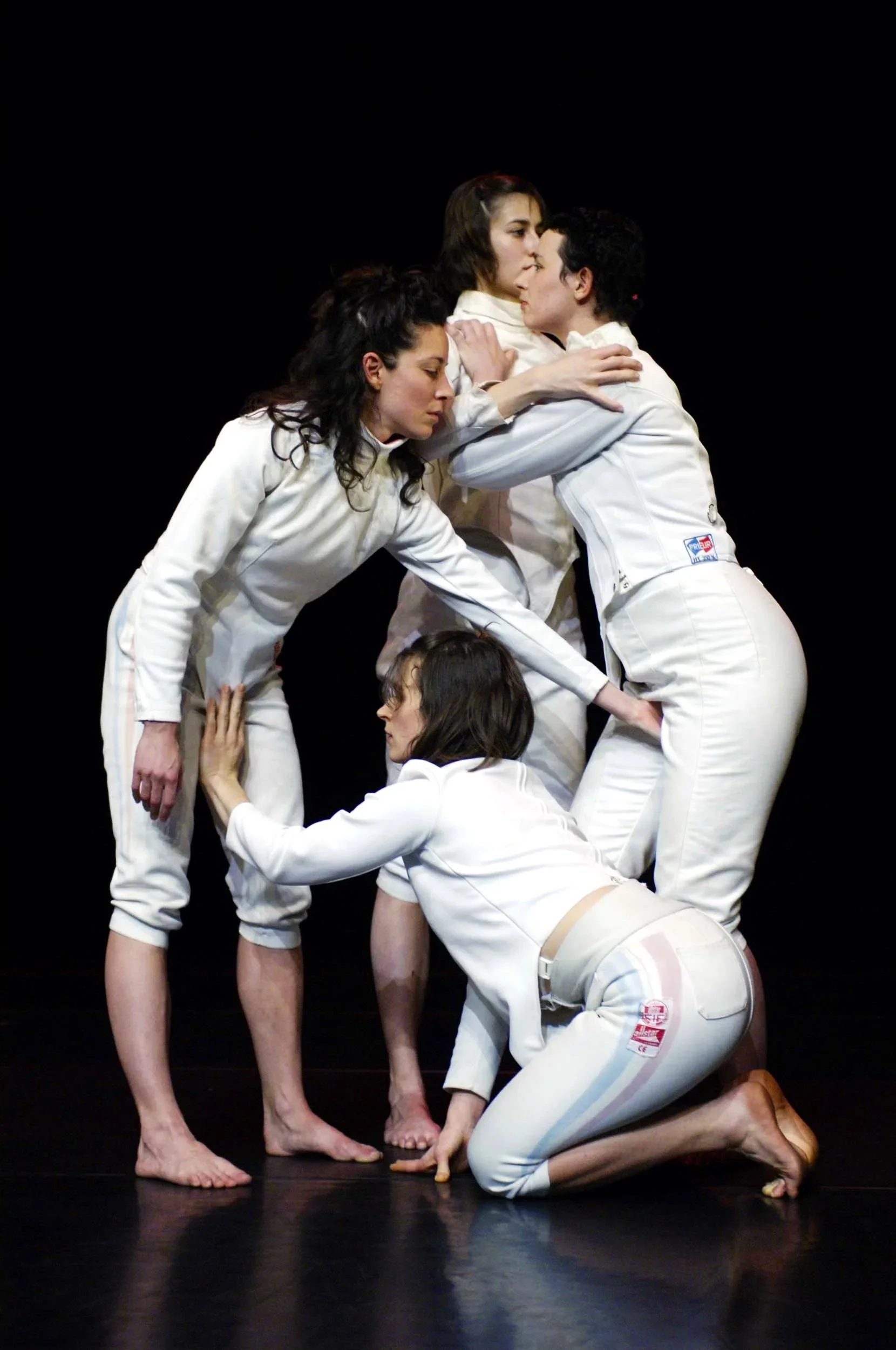
Komposition is a choreographic work initiated by Anne Juren that develops a precise yet open framework for collective practice. At its center lies an ongoing inquiry into how bodies coexist, relate, and remain attentive to one another within a shared space. The work proposes choreography as a living process rather than a fixed structure, shaped through presence, perception, and continuous negotiation. At the core of the piece is the collaboration between Marianne Baillot, Alix Eynaudi, Anne Juren, and Agata Maszkiewicz. In accordance with its title, Komposition unfolds as an act of assembling, a continuous dancing together. The performers remain present throughout, engaging in encounters that emphasize proximity, touch, and responsiveness, while allowing their differences to persist without hierarchy or comparison.
Individual experiences and corporealities become the primary material of the choreography. Gestures emerge, condense, and transform through repetition and subtle variation. This sustained attention to shared action generates moments of quiet intensity and slight disorientation, as perception shifts and the performers encounter their own activity anew.
Accompanied by Karlheinz Stockhausen’s Helicopter String Quartet, the work resonates with a notion of simultaneity and distributed presence. Sound and movement together evoke a layered field in which distance and closeness coexist. Komposition thus articulates a nuanced perspective on collective action, where perception, movement, and relation remain inseparably intertwined.
Concept: Anne Juren
Performer: Marianne Baillot, Alix Eynaudi, Anne Juren, Agata Maszkiewicz
Artistic Assistance: Paula Caspao
Lighting Design: Bruno Pocheron
Lighting Assistance: Victor Duran
Music: Helicopter String Quartet, Karlheinz Stockhausen
Stage Design: Roland Rauschmeier
Production: AIRE (Pauline Roussille) and Wiener Tanz und Kunstbewegung
Co Production: Choreographic Center Linz, Szene Salzburg
Supported by: Cultural Department of the City of Vienna and the Austrian Federal Ministry for Education, Arts and Culture
Thanks to: Berno Odo Polzer
© Sabine Bruckner